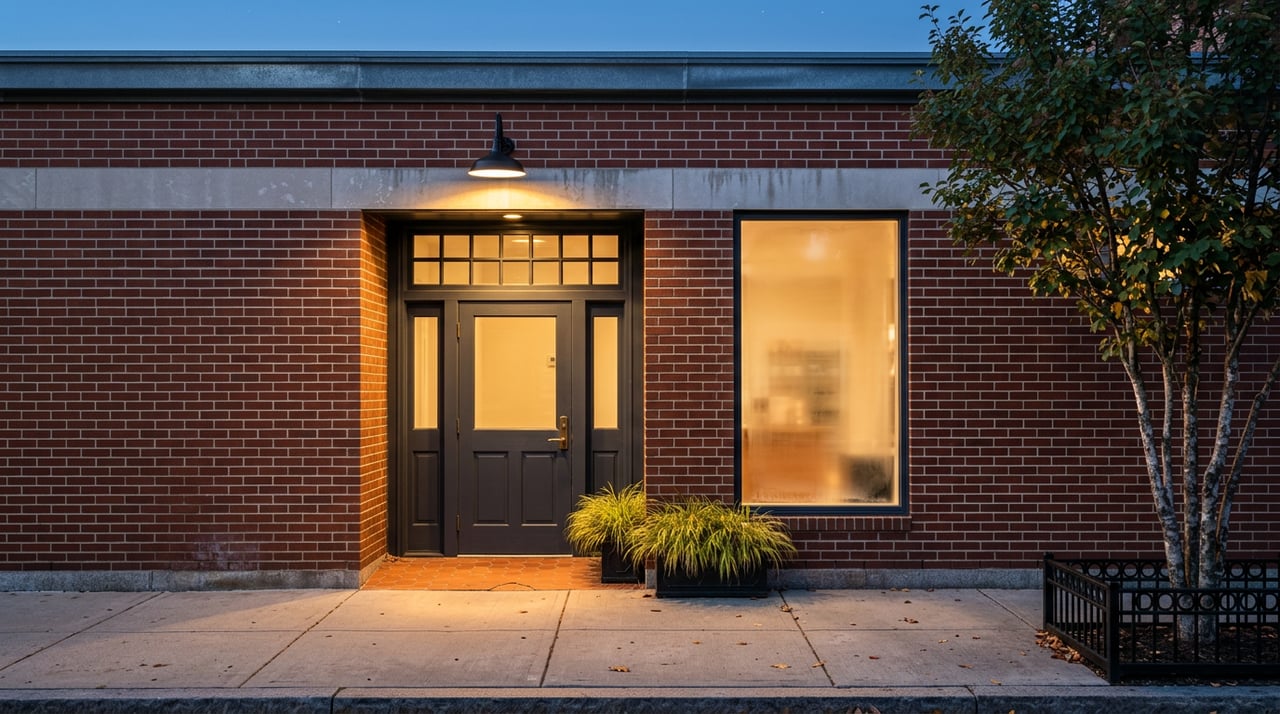
Fulton Market usually gets Chicago's loudest restaurant openings, the kind with investor money behind them and a valet line before the first review runs. This year, one of the most talked-about tables in the city sits inside a 44-seat room on Clark Street, in a neighborhood that already had plenty of good food. Muhājir opened July 1 at 2630 N. Clark St., and it didn't need a hype machine to get attention. It needed a chef who already had a following and chose to build something small and personal in Lincoln Park instead of chasing a bigger stage.
That choice is the pattern worth paying attention to. Look at what has actually opened here in 2026, and a different story emerges than the usual "hot neighborhood" writeup. These aren't restaurateurs testing an unproven market. They're operators who already succeeded somewhere else, deciding this specific stretch of the North Side is where they want their next project to live.
The same team, a harder bet, the same neighborhood twice
Muhājir comes from chef Zubair Mohajir and Jacob Dela Cruz, working alongside a group that also runs Coach House, Lilac Tiger, and Mirra in Bucktown, plus Mariela in the Loop. A week after Muhājir opened, the team debuted Bobo, a Filipino cocktail bar tucked behind it, led creatively by Dela Cruz and named for his father.
The backstory behind that group's approach is more telling than the menu. Beverage director David Mor told the Chicago Sun-Times that the space Mirra now occupies had failed under other operators so many times that the team worried they'd become "just another statistic." Instead, Mirra became one of their biggest successes. That's the model they're repeating in Lincoln Park: don't wait for a neighborhood to prove itself, build something specific enough that the neighborhood proves itself around you.
Dicey's Pizza & Tavern tells a version of the same story from a different angle. The tavern-style pizza spot spent its Chicago run in West Town before closing that location in early January 2026 and relocating to 2435 N. Halsted St., where it celebrated a grand opening on February 22. The move wasn't about finding foot traffic. It was about sitting next door to Parson's Chicken & Fish, its sister restaurant under the same hospitality group, Land and Sea Dept. Two concepts from the same operator, deliberately placed on the same block. That's not a business chasing a trend. That's a business consolidating around a location it already believes in.
Small footprints, familiar names
Two other 2026 arrivals follow the same logic on a smaller scale. Schneider Deli, known for pastrami and matzo ball soup out of its original spot attached to the Ohio House Motel in River North, opened a larger second location at 1733 N. Halsted St. on April 1. Mercadito, the Mexican restaurant with a River North flagship, brought its second Chicago location to Lincoln Park on June 4 under executive chef Alexander Quintero.
Here's the pattern laid out plainly:
| Opening | Address | Date | What it actually is |
|---|---|---|---|
| Dicey's Pizza & Tavern | 2435 N. Halsted St. | Feb. 22, 2026 | Relocation next to sister restaurant Parson's Chicken & Fish |
| Schneider Deli | 1733 N. Halsted St. | April 1, 2026 | Larger second location of a River North original |
| Mercadito | (Lincoln Park) | June 4, 2026 | Second location of the River North flagship |
| Muhājir | 2630 N. Clark St. | July 1, 2026 | New 44-seat concept from an established Chicago team |
| Bobo | 2630 N. Clark St. | July 8, 2026 | Sister cocktail bar behind Muhājir |
None of these are speculative bets from first-time operators hoping a neighborhood catches on. Every name on that list had already built something that worked elsewhere before choosing to put a second flag, or a sequel, in Lincoln Park specifically.
The fall calendar is filling in around the same few blocks
The restaurants aren't the only ones making that choice this year. Two of the neighborhood's signature annual events are converging on a small pocket of Lincoln Park this fall, and one of them just changed addresses to get there.
World Dumpling Fest, now in its sixth year, spent its earlier editions in Logan Square. In 2026, the Chicago Cultural Alliance is hosting the festival in what organizers are calling its new Lincoln Park home at Wrightwood Park, 2555 N. Ashland Ave., running Saturday, September 19 from 11 a.m. to 10 p.m. and Sunday, September 20 from 11 a.m. to 8 p.m. More than ten neighborhood restaurants will serve dumplings from a dozen different culinary traditions, alongside live performances from groups including the Korean Performing Arts Institute of Chicago and the Philippine American Cultural Foundation.
Three weeks later and a few blocks away, the Lincoln Park Wine Fest returns to Jonquil Park, 1001 W. Wrightwood Ave., for its 10th anniversary on October 9 through 11. General admission starts at $30 for a session of tastings and a commemorative glass, with sessions running across the weekend from Friday evening through Sunday afternoon.
Wrightwood Park and Jonquil Park sit close enough together that both festivals effectively anchor the same corner of the neighborhood, three weeks apart, in the same season the restaurant wave landed. That's not a coincidence built by any single marketing plan. It's what happens when a neighborhood becomes the place people default to when they're deciding where something should happen.
What this actually means if you already live here
None of this requires a reservation strategy or a bucket list. It's a reason to walk a few blocks you might not have checked lately. Halsted now has Dicey's at 2435 N. Halsted St., next to Parson's, and a bigger Schneider Deli at 1733 N. Halsted St. Clark Street has a 44-seat restaurant built around migration stories and a Filipino cocktail bar hiding behind it. And on two weekends this fall, nearby parks will host a wine festival and a dumpling festival.
The through line is worth sitting with. When chefs and festival organizers who could locate anywhere in Chicago keep choosing the same several blocks, they're not responding to hype. They're responding to something about the neighborhood's density, its walkability, and its existing appetite that made the bet worth taking. You already live inside that calculation. These openings are one more reason the answer to "where should we go tonight" keeps getting easier to answer without leaving the neighborhood.
If you're weighing what a corner like Armitage and Halsted, or a block near Jonquil Park, is actually worth to live on long term, that's a different conversation, and one grounded in the same local detail as everything above. The Joe Kotoch Group works Lincoln Park block by block, not from a spreadsheet of averages. Start a strategic conversation when you're ready to talk about what these blocks mean for your next move.